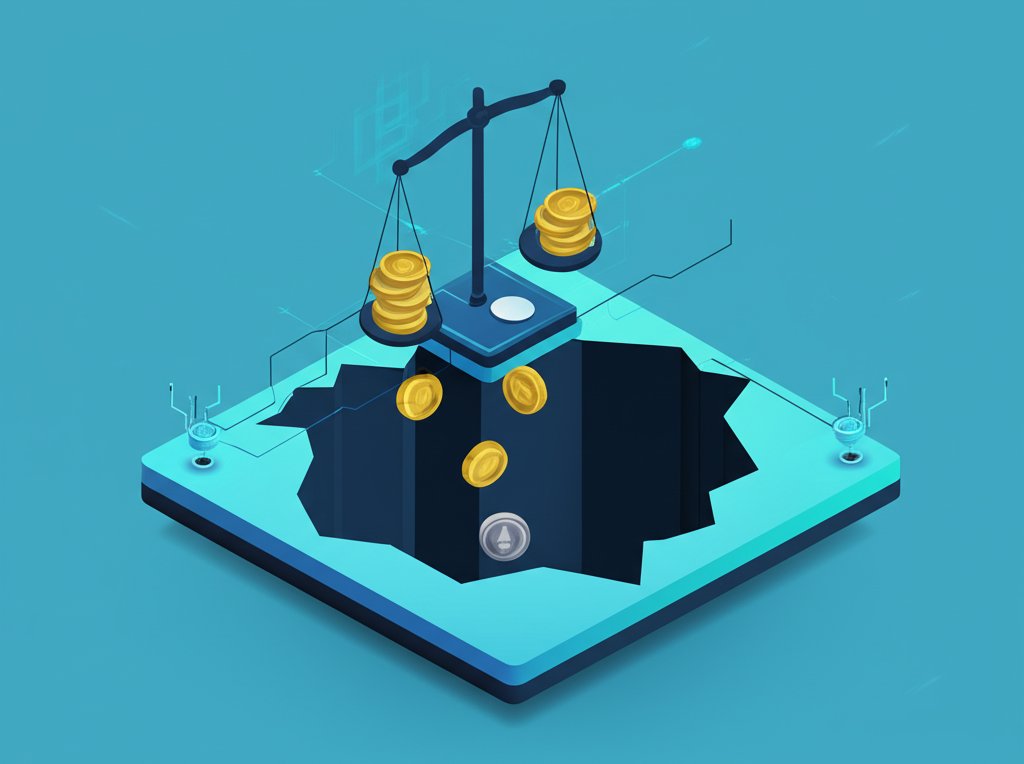
The siren song of high Annual Percentage Yields (APYs) in defi mining is undeniably alluring. It promises a path to passive income in the decentralized finance world, allowing your crypto assets to work for you. Yet, as many seasoned participants know, this vibrant frontier is also rife with hidden traps and significant volatility. The art of successfully navigating defi mining lies in meticulously balancing the potential for outsized rewards against a landscape of complex, often unforgiving risks. It's a game of strategy, knowledge, and calculated exposure.
At a Glance: What You'll Master in DeFi Mining
- Core Mechanics: Understand how liquidity pools function and generate rewards.
- Strategy Spectrum: Differentiate between stablecoin, volatile, and concentrated liquidity mining approaches.
- Risk Deep Dive: Grasp the nuances of Impermanent Loss (IL), smart contract exploits, and rug pulls.
- Mitigation Tactics: Learn actionable steps to protect your capital and minimize exposure.
- Optimization Hacks: Discover tools and techniques to maximize your mining returns.
- Actionable Playbook: Gain practical steps for making informed
defi miningdecisions.
Understanding the Engine Room: What is DeFi Mining?
At its heart, defi mining, often called yield farming, is about contributing your cryptocurrency assets to a decentralized protocol's liquidity pools. Think of these pools as collective funds, governed by smart contracts, that power decentralized exchanges (DEXs) and other DeFi applications. When you supply assets, you become a "Liquidity Provider" (LP), facilitating trades and other operations.
This process is fundamental to Automated Market Makers (AMMs), which use mathematical formulas (like the classic X*Y=K) to automatically balance asset ratios within a pool. When you deposit an equal value of two tokens – say, ETH and USDT – you're essentially providing the necessary inventory for traders to swap between those assets. In return for your service, you receive LP tokens, which represent your share of the pool.
Your rewards from defi mining typically come from two main sources:
- Transaction Fees: A small percentage (e.g., 0.3%) of every trade made within the pool is distributed proportionally to LPs.
- Protocol Native Tokens: Many DeFi protocols incentivize LPs by distributing their own governance or utility tokens (like UNI from Uniswap or CRV from Curve). These tokens are often inflationary, aiming to attract more liquidity in the early stages of a project.
Navigating the Reward Landscape: Types of DeFi Mining Pools & Strategies
The world of defi mining isn't one-size-fits-all. Different pools and strategies offer varying risk-reward profiles. Your choice depends heavily on your risk tolerance, capital, and how actively you're willing to manage your positions.
1. Stablecoin Pools: The Low-Volatility Approach
Example: USDC/USDT, DAI/USDC
How it works: You deposit two stablecoins, which are cryptocurrencies pegged to a fiat currency like the US dollar. Because the price correlation between these assets is high, the risk of Impermanent Loss (which we'll cover shortly) is significantly reduced.
Pros:
- Lower Impermanent Loss: Minimal price fluctuation between assets means less divergence from your initial deposit value.
- Predictable Returns: Generally offer more stable, albeit often lower, Annual Percentage Yields (APYs) compared to volatile asset pools.
Cons: - Lower APYs: Rewards are typically less enticing than those from pools with more volatile assets.
- Single-Point Failure Risk: Still exposed to smart contract risks and potential de-pegging events if a stablecoin fails.
2. Volatile Asset Pools: Chasing Higher APYs
Example: ETH/USDC, BTC/ETH
How it works: These pools involve at least one (or both) highly volatile cryptocurrencies. The potential for higher trading volume and larger native token incentives often translates to higher advertised APYs.
Pros:
- Higher Potential APY: Can offer significantly better returns if the market is favorable and protocol incentives are generous.
- Leverage on Asset Appreciation: You benefit if both assets appreciate, though this is balanced against IL.
Cons: - High Impermanent Loss (IL): This is the primary risk. Significant price divergence between the assets can eat into or even negate your gains. A 2x price change between assets can lead to roughly a 5.7% Impermanent Loss relative to simply holding the assets. A 3x change pushes this to about 13.4%, and a 5x change to 25.5%.
- Market Volatility: Exposed to broader crypto market swings.
3. Concentrated Liquidity: The Active LP's Edge (e.g., Uniswap v3)
Example: ETH/USDC on Uniswap v3
How it works: Unlike older AMMs where liquidity is spread uniformly across all possible price ranges, concentrated liquidity allows LPs to provide capital within specific, custom price ranges. If the trading pair remains within your specified range, your capital is utilized much more efficiently, earning higher fees.
Pros:
- Capital Efficiency: Significantly higher fee earnings on the same amount of capital if the price stays within your range.
- Customization: Tailor your risk exposure and reward potential by choosing narrow or wide ranges.
Cons: - Active Management Required: If the price moves outside your chosen range, your liquidity becomes idle, and you stop earning fees. You also incur 100% Impermanent Loss (on one side of the pair) until the price returns. This necessitates constant monitoring and rebalancing, which can be costly in gas fees.
- Increased Impermanent Loss Risk: While efficient, if the price moves significantly outside your range, the IL can be substantial and rapid.
4. Leveraged Strategies: Amplifying Gains (and Losses)
How it works: This involves borrowing assets to increase your LP position. For instance, you might deposit ETH into a lending protocol, borrow stablecoins against it, and then pair those stablecoins with more ETH (or another asset) to enter a liquidity pool.
Pros:
- Amplified Returns: If the underlying
defi miningstrategy is profitable, leverage can significantly boost your net gains.
Cons: - Amplified Risks: Liquidation risk from borrowed assets, increased Impermanent Loss exposure, and magnified gas fees from more complex transactions. This is for advanced users only.
5. Cross-Protocol & Cross-Chain Mining: The Multi-Layered Approach
How it works: This involves staking your LP tokens (obtained from one pool) into another DeFi protocol to earn additional rewards (e.g., "yield farming" your LP tokens). Cross-chain strategies involve bridging assets across different blockchains (e.g., Ethereum to Polygon) to access different pools and incentives.
Pros:
- Compounding Rewards: Staking LP tokens can lead to additional token emissions.
- Access to New Opportunities: Different chains and protocols offer unique APYs and token incentives.
Cons: - Increased Complexity: Managing assets across multiple protocols and chains adds layers of potential failure points and monitoring.
- Bridging Risks: Cross-chain bridges are frequent targets for exploits, as seen with the Ronin Network hack, which involved losses of over $625 million.
The Shadow Side: Unpacking DeFi Mining's Core Risks
While the promise of passive income is attractive, the decentralized nature of defi mining introduces a unique set of hazards. Understanding these is not just prudent; it's essential for survival. For a broader look at the overall risk landscape, you can refer to our guide on DeFi mining income and risks.
1. Impermanent Loss (IL): The Silent Value Eroder
Impermanent Loss is arguably the most significant risk for liquidity providers. It's the difference in value between simply holding (HODLing) your assets versus providing them to a liquidity pool when the price of those assets changes.
How it happens: AMMs maintain a constant product (X*Y=K). When the price of one asset in the pair changes relative to the other, arbitrageurs step in. They buy the relatively cheaper asset from the pool and sell the relatively more expensive one until the pool's ratio matches the market price. This rebalancing means that when you withdraw your liquidity, you'll have more of the asset that depreciated and less of the asset that appreciated, compared to if you had just held them separately.
The "Impermanent" aspect: The loss is "impermanent" because it only materializes when you withdraw your liquidity. If the asset prices return to their original ratio when you entered the pool, the Impermanent Loss disappears. However, this rarely happens perfectly, and the capital opportunity cost is very real.
IL Impact Examples:
- 2x Price Change: If one asset's price doubles relative to the other (e.g., ETH goes from $2000 to $4000 while USDT stays at $1), you face an IL of approximately 5.7%.
- 3x Price Change: An asset tripling in value leads to roughly 13.4% IL.
- 5x Price Change: A fivefold increase means an IL of around 25.5%.
It's critical to remember that your fee earnings and native token rewards must outweigh this IL for yourdefi miningventure to be profitable.
2. Smart Contract Vulnerabilities: The Code is Law, Until It's Not
DeFi protocols are built on smart contracts – self-executing code on the blockchain. While innovative, these contracts are only as secure as their programming. Bugs, exploits, or architectural flaws can lead to catastrophic losses.
Real-world impact: We've seen numerous instances of smart contract hacks, from re-entrancy attacks to flash loan exploits. The Ronin Network bridge exploit, where a vulnerability in the bridging mechanism led to the loss of over $625 million in user funds, serves as a stark reminder of these systemic risks. Always prioritize protocols with a proven track record, multiple audits by reputable firms, and ongoing bug bounty programs.
3. Rug Pulls: The Deceptive Exit
A rug pull is a malicious maneuver in the crypto space where developers abandon a project, taking all investor funds with them. This is particularly prevalent in new, unaudited defi mining projects offering unsustainably high APYs.
How it happens: A common scenario involves developers creating a new token, pairing it with a legitimate asset (like ETH or USDT) in a liquidity pool, and then heavily promoting the pool with exorbitant rewards. Once enough liquidity is provided by unsuspecting users, the developers dump all their own tokens from the pool, draining the paired asset and leaving LPs holding worthless tokens. The "Squid Game" token, which drained $3.3 million from investors, is a notorious example.
4. Market Volatility & Slippage: The Ever-Present External Factors
Beyond protocol-specific risks, defi mining remains exposed to broader crypto market dynamics.
- Market Volatility: Sudden crashes can impact the value of your underlying assets, even if your
defi miningstrategy is otherwise sound. - Slippage: For large trades, or in illiquid pools, the execution price can diverge from the expected price. While more of a trading risk, LPs in thinly traded pools might experience higher IL if arbitrageurs are moving significant capital.
Your Defensive Playbook: Mitigating DeFi Mining Risks
Navigating defi mining profitably isn't just about chasing the highest APY; it's about shrewd risk management. Here's how to build a robust defense.
1. Strategic Asset Pair Selection
- Correlated Assets: Opt for pools with highly correlated assets, like stablecoin-to-stablecoin (USDC/DAI) or even BTC/ETH (which tend to move in tandem, albeit with some divergence) to minimize Impermanent Loss. These often provide more modest returns but come with greater peace of mind.
- Avoid "Shitcoin" Pairs: Steer clear of pools involving newly launched, unproven tokens with highly volatile or manipulative price action. These are fertile ground for rug pulls and extreme IL.
2. Protocol Audits & Track Record
- Due Diligence: Always verify if a protocol has been audited by reputable firms (e.g., CertiK, PeckShield, ConsenSys Diligence). Audits aren't a guarantee against all bugs, but they significantly reduce the risk of major vulnerabilities.
- Time in Market: Prioritize established protocols with a longer track record of secure operation and significant Total Value Locked (TVL). Newer projects carry inherent experimental risk.
3. Diversification Across Pools and Chains
- Spread Your Bets: Instead of putting all your capital into a single high-APY pool, diversify across multiple pools with different asset pairs and risk profiles.
- Multi-Chain Approach: Explore
defi miningopportunities on various robust blockchains (e.g., Ethereum, Polygon, Arbitrum, Avalanche). This reduces exposure to single-chain network failures or gas fee spikes.
4. Impermanent Loss Protection Mechanisms
Some innovative protocols are designed to mitigate IL.
- Bancor v3: Offers "Single-Sided Staking with Impermanent Loss Protection." LPs can deposit a single token, and after a vesting period (e.g., 30 days for 100% protection), Bancor's native token (BNT) acts as an insurer against IL, guaranteeing the initial dollar value of the deposited asset. This significantly de-risks LP positions.
- Managed Vaults: Some yield aggregators (like Yearn Finance) offer vaults that actively manage liquidity, seeking to reduce IL through complex strategies, though these can come with their own management fees.
5. Decentralized Insurance
Consider decentralized insurance platforms like Nexus Mutual or InsurAce. These protocols offer coverage against smart contract exploits, oracle failures, and even certain stablecoin de-pegging events. It's an added layer of protection, though coverage terms and costs vary.
6. Active Monitoring and Rebalancing
- Stay Informed: Regularly monitor market conditions, protocol announcements, and the performance of your
defi miningpositions. Use dashboards like DeFiLlama, Zapper, or Zerion to track your portfolio's TVL and individual pool performance. - Rebalance or Withdraw: If a pool's APY drops significantly, IL becomes too high, or a protocol shows signs of instability, be prepared to rebalance your position or withdraw your liquidity. This might incur gas fees but can prevent larger losses.
Maximizing Your Returns: Strategies for Optimization
Once you have a handle on risk, you can focus on intelligently enhancing your defi mining yields.
1. APR vs. APY: Understanding the Compounding Effect
- APR (Annual Percentage Rate): This represents a simple interest rate, usually without considering the effect of compounding.
- APY (Annual Percentage Yield): This includes the effect of compounding, where the interest earned is reinvested to earn more interest. In
defi mining, APY is generally what you're after, as you want to automatically reinvest earned tokens or fees back into the pool to maximize future gains. Always look for APY when comparing returns.
2. Calculating Potential Impermanent Loss
Before committing funds, use online IL calculators or spreadsheet models to estimate potential Impermanent Loss based on various price change scenarios. Factor this into your projected net returns. If a pool's projected APY barely covers the expected IL from typical price volatility, it might not be worth the risk.
3. Yield Aggregators: Automating and Optimizing
Protocols like Yearn Finance, Beefy Finance, or Convex Finance act as "yield aggregators." They take your deposited assets, deploy them into various defi mining strategies across different protocols, and automatically compound rewards.
Benefits:
- Automated Compounding: Aggregators automatically reinvest your earned tokens, saving you gas fees and time compared to manual compounding.
- Optimized Strategies: They often employ complex strategies to maximize returns, sometimes moving assets between pools or using leverage in a managed way.
- Gas Fee Efficiency: By pooling funds, they spread gas costs across many users, making compounding more efficient.
Considerations: - Additional Smart Contract Risk: You're adding another layer of smart contract risk by interacting with the aggregator's contracts.
- Management Fees: Aggregators typically charge a small performance or withdrawal fee.
4. Analytics Dashboards: Your Personal DeFi Command Center
Essential tools for active LPs include:
- DeFiLlama: Tracks Total Value Locked (TVL) across virtually all DeFi protocols and chains. A high TVL usually indicates greater trust and liquidity.
- Zapper / Zerion: These dashboards provide a comprehensive overview of your personal DeFi portfolio, showing your assets across different protocols, current
defi miningpositions, and accumulated rewards. This is invaluable for monitoring performance and making timely adjustments. - Token Terminal / Dune Analytics: For deeper fundamental analysis, these platforms offer metrics on protocol revenue, user growth, and tokenomics, helping you assess the long-term viability of an incentivized token.
Practical Application: Setting Up an ETH/USDC Position on Uniswap v2
Let's walk through a simplified example of entering a liquidity pool, focusing on the decision points.
- Research: You identify an ETH/USDC pool on Uniswap v2 offering a decent APR (say, 15%) from fees, plus an additional incentive token from a third-party farm, boosting the APY to 30%.
- Asset Acquisition: You have $2,000 to allocate. You buy $1,000 worth of ETH and $1,000 worth of USDC.
- Providing Liquidity:
- Navigate to the Uniswap v2 "Pool" interface.
- Connect your MetaMask wallet.
- Select the ETH/USDC pair.
- Input the amount of USDC you want to supply (e.g., 1000 USDC). The interface will automatically calculate the equivalent amount of ETH needed based on the current market price.
- Approve USDC (first time only) and then confirm the "Supply" transaction.
- Receiving LP Tokens: Once the transaction is confirmed, you'll receive Uniswap V2 ETH-USDC LP tokens in your wallet. These tokens represent your share of the pool.
- Staking for Additional Rewards (Optional): If there's an external farm offering additional incentives, you'd then take these LP tokens to that farm's staking interface, approve them, and stake them to earn the incentive token.
- Monitoring: Regularly check your position on Zapper/Zerion. Monitor the ETH/USDC price movement on a charting platform. Calculate your potential IL if ETH's price deviates significantly. Keep an eye on the APY of the farm; incentives can dry up quickly.
- Decision Point: If ETH suddenly drops 50% against USDC, you'll incur substantial IL. You must decide: do you cut your losses and withdraw, or do you hold, hoping for a price recovery and for your fee/incentive rewards to offset the IL?
This hands-on approach highlights the need for constant vigilance and a clear exit strategy.
Quick Answers: Your DeFi Mining FAQ
Is Impermanent Loss permanent?
No, it's called "impermanent" because it can theoretically disappear if the prices of the assets return to their original ratio when you first provided liquidity. However, in practice, a full return to the original ratio is rare, and the opportunity cost of having your capital tied up and potentially losing value is very real. It's often "permanent enough" to be a significant concern.
Is defi mining truly passive income?
It can be, but often requires more active management than advertised. While you're not actively trading, you need to monitor market conditions, gas fees, protocol health, and APY fluctuations to optimize returns and mitigate risks. Concentrated liquidity, for instance, is far from passive.
How do I know if a defi mining project is legitimate?
Look for audited smart contracts, a well-established team, significant and stable Total Value Locked (TVL), clear tokenomics, and a community that isn't solely focused on "to the moon" hype. If the APY seems too good to be true (e.g., millions of percent), it almost certainly is.
What are "gas fees" and how do they impact defi mining?
Gas fees are transaction costs on blockchain networks (like Ethereum) that you pay to execute smart contract interactions (depositing, withdrawing, claiming rewards). High gas fees can significantly eat into your profits, especially for smaller capital amounts or frequent rebalancing. Consider using defi mining protocols on lower-cost chains like Polygon or Arbitrum if gas fees are a concern.
Can I lose more than my initial investment?
In defi mining (excluding leveraged positions), your maximum loss is typically the value of your initial deposit, primarily due to Impermanent Loss or a complete rug pull/smart contract exploit. However, with leveraged positions or if you borrow against your LP tokens, your liquidation risk and potential for losses can exceed your initial capital.
Your Next Steps in DeFi Mining
DeFi mining is a powerful tool for generating yield in the crypto space, but it's a double-edged sword. To move forward intelligently, consider these actionable steps:
- Start Small, Learn Fast: Don't commit a significant portion of your portfolio to
defi mininguntil you've gained practical experience. Begin with a smaller, manageable amount to understand the mechanics and risks firsthand. - Prioritize Stablecoin Pools (Initially): For your first foray, consider stablecoin-to-stablecoin pools. The lower Impermanent Loss risk makes them a safer training ground.
- Master Impermanent Loss: Dedicate time to truly understand IL. It's the most common and often misunderstood risk. Use online calculators to run scenarios.
- Leverage Analytics Tools: Make dashboards like Zapper or DeFiLlama your daily companions. Monitor your positions and the overall health of the protocols you're engaging with.
- Diversify Strategically: Once comfortable, spread your capital across different types of pools, assets, and even blockchains to distribute risk.
- Stay Informed, Stay Safe: The DeFi landscape evolves rapidly. Follow reputable crypto news sources, security audit firms, and project communities. Be wary of hype and always, always do your own research.
By approachingdefi miningwith a clear understanding of both its immense potential and its inherent dangers, you position yourself not just to survive, but to thrive in the decentralized financial revolution.